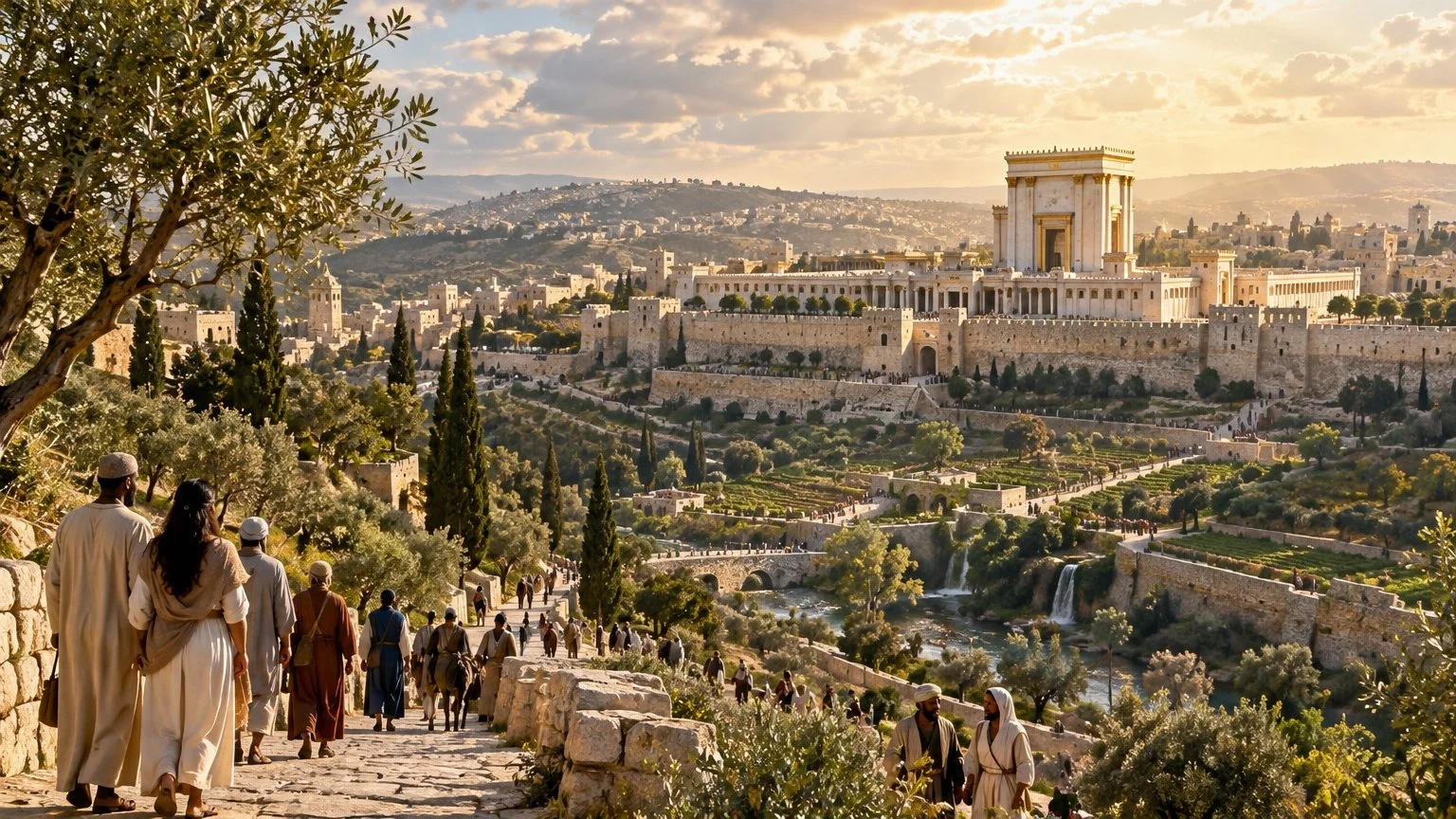
The Restoration of Israel, the Reign of the Saints, and the Renewal of Creation
The Return of Christ and the Establishment of His Kingdom
The return of Jesus Christ will inaugurate one of the most extraordinary periods in human history: the establishment of His righteous kingdom on earth. For a thousand years, the Messiah will reign over Israel and the nations, fulfilling God’s everlasting covenant promises, restoring David’s throne, and bringing unprecedented peace, justice, and prosperity to creation. The Apostle John describes this period in Revelation 20:1–6, where Satan is bound and the resurrected saints reign with Christ for a thousand years. While the Millennium is only mentioned in this one chapter of Revelation, it is repeated five times, indicating its importance in our eschatological understanding of God’s Kingdom and the chronological specificity about what will happen at both the beginning and the end.
Although Christians broadly affirm the future return of Jesus Christ, they differ concerning the nature and timing of His Kingdom. Amillennial, postmillennial, and premillennial interpretations offer different understandings of how biblical prophecy is fulfilled, particularly regarding Israel, the nations, and the relationship between the present age and the eternal state. In the premillennial understanding developed in our previous teaching, the Millennium is understood as a future, earthly reign inaugurated by Christ’s second coming. Christ returns bodily to the Mount of Olives in Jerusalem to establish His Kingdom on earth, restore Israel, and govern the nations alongside His resurrected and glorified saints.
Having previously examined the biblical foundation for a literal Millennial Kingdom and its significance for God’s covenant promises to Israel, we now turn to a different question: What will this Kingdom actually look like? How will Christ govern the nations? What role will His glorified saints fulfill? How will mortal humanity live under His righteous administration? And why will sin and death continue to exist during a period characterized by the visible reign of the Messiah?
These questions lead us into the remarkable prophetic descriptions of Israel’s restoration, the renewal of David’s dynasty, the restoration of the Temple and priesthood, and the transformation of creation itself. They also require us to distinguish carefully between the Millennial Kingdom and the eternal state that follows.
One particularly interesting theological question we will answer is the relationship between resurrected, glorified saints and the mortal populations inhabiting the Millennial Kingdom. This distinction has important implications for understanding the administration of Christ’s government, the continuation of ordinary human life, and the existence of sin and death during the Millennium. Another important question concerns Ezekiel’s restored priesthood and sacrifices and how these ordinances relate to the completed atonement of Christ.
The Millennium: An Intermediate Kingdom Before the Eternal State
The Millennium is not the final restoration of creation, but an intermediate stage in the consummation of God’s redemptive purposes. Christ reigns over a world that has experienced substantial restoration, yet sin and death have not been completely abolished. It is particularly important when considering Paul’s description of Christ’s reign, where he says: “Then comes the end, when He delivers the kingdom to God the Father, when He puts an end to all rule and all authority and power. For He must reign till He has put all enemies under His feet. The last enemy that will be destroyed is death” (1 Corinthians 15:24–26).
Paul’s sequence is especially significant. Christ’s reign involves the progressive subjugation of His enemies, culminating in the destruction of death itself. Revelation 20:7–15 provides a corresponding sequence: Satan is released after the thousand years, the nations are deceived into a final rebellion, judgment follows, and death and Hades are cast into the lake of fire. Only afterward does John describe the new heaven and new earth in Revelation 21. It creates three distinguishable stages in God’s redemptive program:
Isaiah 65:20 is especially interesting because it describes extraordinary longevity while acknowledging the continued possibility of death. Under a premillennial reading, this suggests an earthly order dramatically transformed by Christ’s government but not yet possessing the incorruptibility of the eternal state. The Millennium therefore shows what human civilization will look like when Satan’s deception is restrained, Christ governs the nations in righteousness, and glorified saints exercise delegated authority over mortal humanity. Yet even under these extraordinary peaceful and prosperous conditions, the final rebellion of Revelation 20:7–9 shows that a perfectly righteous government does not eliminate the possibility of human rebellion.
It is a profound theological distinction. The problem of sin is not simply the corruption of earthly governments, social institutions, or spiritual influences. Sin also originates within the unredeemed human heart. Consequently, the Millennium reveals both the perfection of Christ’s government and the continuing need for the final eradication of sin and death.
Paul writes, “For the earnest expectation of the creation eagerly waits for the revealing of the sons of God” (Romans 8:19). However, it is important to distinguish between the manifestation of the glorified sons of God at Christ’s return and creation’s ultimate deliverance from corruption at the end of the Millennium. Since Romans 8 does not explicitly divide these events into two stages, this remains a theological synthesis rather than a distinction Paul states directly. Still, we surmise that the first stage aligns with the inauguration of the Millennial Kingdom, while the latter stage culminates in the new creation. It raises another question: What distinguishes Christ’s government during the Millennium from His eternal reign in the new creation?
Daniel 7:14 and Luke 1:33 declare that His kingdom will never end. Yet 1 Corinthians 15:24–28 describes Christ delivering the kingdom to the Father after every enemy has been subdued. The distinction is not that Christ ceases to reign, but that His mediatorial reign over a creation still containing enemies reaches its appointed fulfillment. In contrast, His eternal reign continues in a creation where no enemies remain.
Therefore, the Millennial Kingdom is the earthly manifestation of Christ’s messianic reign, during which Israel is restored, God’s covenant promises are fulfilled, and the resurrected saints participate in governing the nations. Although Satan’s influence is restrained and creation experiences an extraordinary measure of renewal, the world remains inhabited by mortal humanity, and sin and death have not yet been abolished. The Millennium therefore constitutes an intermediate stage in God’s redemptive purposes, culminating in Satan’s final defeat, the destruction of death, and the establishment of the new heaven and new earth.
Understanding the Millennium as an intermediate Kingdom raises another important question: Who will exercise authority over the nations during Christ’s reign? Scripture reveals that the present world order is influenced by spiritual principalities and powers, while the coming Kingdom promises to Christ and His glorified saints all governmental authority. This transformation of dominion provides another dimension of God’s purpose in restoring humanity’s original calling to govern creation under His authority.
From Angelic Dominion to the Government of Christ and His Saints
Scripture describes a present world order in which spiritual principalities and powers exercise influence over earthly kingdoms. For example, in Daniel 10:13, 20–21, we encounter the princes of Persia and Greece, alongside Michael, the prince associated with Israel. These appear to be supernatural authorities connected with particular nations. Paul similarly describes the spiritual conflict confronting believers, saying, “For we do not wrestle against flesh and blood, but against principalities, against powers, against the rulers of the darkness of this age, against spiritual hosts of wickedness in the heavenly places” (Ephesians 6:12, NKJV).[i]
Deuteronomy 32:8–9 is particularly significant: “When the Most High divided their inheritance to the nations, When He separated the sons of Adam, He set the boundaries of the peoples According to the number of the children of Israel. For the Lord’s portion is His people; Jacob is the place of His inheritance.” The Dead Sea Scrolls and Septuagint preserve a reading referring to the “sons of God” or angels of God, rather than the Masoretic Text’s “sons of Israel.” It has led some scholars to understand the passage as describing a heavenly allotment of the nations, with Israel belonging uniquely to the Lord. Taken together, these passages provide a foundation for understanding the present world order as involving supernatural powers associated with the nations.
The extraordinary development is that Scripture promises governing authority to Christ’s redeemed people—the church. Christ declares: “And he who overcomes, and keeps My works until the end, to him I will give power over the nations—He shall rule them with a rod of iron; They shall be dashed to pieces like the potter’s vessels—as I also have received from My Father” (Revelation 2:26–27). Daniel anticipated this future transfer of authority, saying, “Then the kingdom and dominion, And the greatness of the kingdoms under the whole heaven, Shall be given to the people, the saints of the Most High. His kingdom is an everlasting kingdom, And all dominions shall serve and obey Him” (Daniel 7:27). And Paul asks, “Do you not know that the saints will judge the world? And if the world will be judged by you, are you unworthy to judge the smallest matters? 3 Do you not know that we shall judge angels? How much more, things that pertain to this life?” (1 Corinthians 6:2-3).
These passages establish a remarkable connection between the saints’ glorification and their future governmental responsibilities. And the distinctions between Israel and the church matter because Israel’s restoration does not imply that it replaces the authority bestowed upon the church. Jesus Himself said to His disciples, “Assuredly I say to you, that in the regeneration, when the Son of Man sits on the throne of His glory, you who have followed Me will also sit on twelve thrones, judging the twelve tribes of Israel” (Matthew 19:28).
The fullness of God’s covenant promises to Israel is that they would become a kingdom of priests and a holy nation. Paul says in Romans 9 that the promises belong to Israel, his countrymen according to the flesh, who are Israelites.[ii] However, God also promised that Abraham would become the father of many nations.[iii] Hence, Christ’s Kingdom is expanded to inherit all the nations for His inheritance, and the ends of the earth for His possession.[iv] In other words, Christ’s Kingdom becomes Israel plus the nations, the great assembly of nations, the ecclesia (kahal in Hebrew), which we know as the church.
Peter affirms this promise in speaking to the church, saying, “You are a chosen generation, a royal priesthood, a holy nation, His own special people, that you may proclaim the praises of Him who called you out of darkness into His marvelous light” (1 Peter 2:9). In other words, Israel was to become a royal priesthood through which Christ would shepherd the nations. And now, because Israel largely rejected her Messiah, that promise has been extended to the Gentiles who receive Christ.[v] Together with their Jewish brethren, we have become one new man, to rule and reign with Jesus over the nations.
In the present age, fallen spiritual powers influence and deceive the nations, while God’s redeemed people frequently experience persecution and marginalization. However, in the coming Kingdom, the governing order is reversed. The rebellious spiritual authorities are judged by the church, Christ receives the kingdoms of this world, and His resurrected and glorified saints participate in administering His righteous government over the nations. We read, “For He has not put the world to come, of which we speak, in subjection to angels” (Hebrews 2:5). This passage supports the theological principle that the coming order is centered on Christ’s glorified humanity rather than angelic dominion. Thus, humanity’s intended dominion is fulfilled through Jesus Christ. In His Kingdom, Christ rules the nations, and the church reigns with Him.
The Millennial Kingdom, therefore, represents not only the restoration of Israel and David’s throne, but also the restoration of humanity’s intended dominion over creation. Through Christ, the Second Adam, redeemed and glorified humanity assumes a governing responsibility over the nations that had previously been subject to the influence of rebellious spiritual powers. This transfer of dominion and authority to Christ and His church connects the Millennium to the original creation mandate in Genesis 1:26–28, the dominion promised to the Son of Man in Daniel 7, and the inheritance of the nations promised to Christ and His saints.
The Millennial Kingdom will therefore reveal a profound transformation in the government of the nations. The authority of Christ and His glorified saints will replace the rebellious systems that have characterized the present age, fulfilling humanity’s original calling to exercise dominion under God. Yet the establishment of this righteous government is inseparable from God’s covenant promises to Israel, for it is through the promised Son of David that the nations will ultimately be governed. We must therefore begin with the restoration of Israel, the nation through which God promised to establish His Kingdom upon the earth.
The Restoration of Israel: God’s Covenant Nation
The promise that God would regather Israel from the nations and restore the descendants of Abraham, Isaac, and Jacob to their ancestral land is one of the most frequently repeated prophetic themes in the Old Testament. God’s promises to Israel include the permanent possession of the land, the reunification of the two kingdoms, Israel and Judah, into one kingdom ruled by one king, the Davidic Messiah, and the return of God’s presence to His people. The restoration of Israel does not imply that God has two separate redeemed people groups. Jews and Gentiles share salvation through Christ, and still, God’s unique covenant promises concerning Israel are relevant to the natural descendants of Abraham. And here, I believe, is where we begin to find confusion within the church. Doesn’t God only have one people?
He does, but having one people doesn’t mean He doesn’t make distinctions within His family. God can have one people comprised of every tongue, tribe, nation, and people. In fact, we find these exact words in Revelation: “They sang a new song, saying: “You are worthy to take the scroll, And to open its seals; For You were slain, And have redeemed us to God by Your blood Out of every tribe and tongue and people and nation” (Revelation 5:9). Still, within God’s Kingdom, Israel continues to stand at its center. Christ is the rightful heir of King David, Israel’s one King, and He will govern all the nations, including Israel, from Jerusalem.
Twenty-five major prophetic passages explicitly describe Israel’s regathering, return to the land, or restoration to its national inheritance, and the number increases considerably if we include parallel prophecies, covenant reaffirmations, and passages describing Israel’s restoration without explicitly mentioning a geographical return.[vi] The text includes explicit promises of Israel’s regathering, her national and spiritual restoration, and her permanent covenant inheritance.
The earliest promise concerning Israel’s restoration is found in Deuteronomy, where Moses declared: “The Lord your God will bring you back from captivity, and have compassion on you, and gather you again from all the nations where the Lord your God has scattered you. If any of you are driven out to the farthest parts under heaven, from there the Lord your God will gather you, and from there He will bring you. Then the Lord your God will bring you to the land which your fathers possessed, and you shall possess it” (Deuteronomy 30:3-5).
Later, we find the same promise of Israel’s regathering and restoration in the prophets:
“For behold, the days are coming, says the Lord, that I will bring back from captivity My people Israel and Judah, says the Lord. And I will cause them to return to the land that I gave to their fathers, and they shall possess it” (Jeremiah 30:3).
“For I will take you from among the nations, gather you out of all countries, and bring you into your own land. Then I will sprinkle clean water on you, and you shall be clean; I will cleanse you from all your filthiness and from all your idols. I will give you a new heart and put a new spirit within you; I will take the heart of stone out of your flesh and give you a heart of flesh. I will put My Spirit within you and cause you to walk in My statutes, and you will keep My judgments and do them. Then you shall dwell in the land that I gave to your fathers; you shall be My people, and I will be your God” (Ezekiel 36:24-28).
“Thus says the Lord God: Surely I will take the children of Israel from among the nations, wherever they have gone, and will gather them from every side and bring them into their own land; and I will make them one nation in the land, on the mountains of Israel; and one king shall be king over them all; they shall no longer be two nations, nor shall they ever be divided into two kingdoms again. They shall not defile themselves anymore with their idols, nor with their detestable things, nor with any of their transgressions; but I will deliver them from all their dwelling places in which they have sinned, and will cleanse them. Then they shall be My people, and I will be their God” (Ezekiel 37:21-23).
“I will bring back the captives of My people Israel; They shall build the waste cities and inhabit them; They shall plant vineyards and drink wine from them; They shall also make gardens and eat fruit from them. I will plant them in their land, And no longer shall they be pulled up From the land I have given them, Says the Lord your God” (Amos 9:14-15).
Many more verses in Scripture prove God’s covenant faithfulness toward Israel. Still, in these five alone, we confirm not only God’s intention to gather Israel back to the land He promises to the descendants of Abraham. Additionally, we find specific mention of Israel and Judah being restored as one nation under one king. And we see God cleansing Israel, giving them a new heart and a new spirit so they should not defile themselves again with idols, and causing Israel to walk in God’s statutes and judgments. God promises to be their God, and He promises to make Israel His people. Israel is regathered physically, restored spiritually, and receives her permanent covenant promises under the reign of her King, Jesus-Yeshua.
Israel’s restoration, however, involves more than her return to the land and spiritual renewal. The prophets consistently connect her national restoration with the reunification of Israel and Judah under one King, the promised descendant of David. God’s covenant with Israel is therefore inseparable from His everlasting covenant with David, whose throne and kingdom He promised to establish forever. As it says, “Surely I will take the stick of Joseph, which is in the hand of Ephraim, and the tribes of Israel, his companions; and I will join them with it, with the stick of Judah, and make them one stick, and they will be one in My hand… and I will make them one nation in the land, on the mountains of Israel; and one king shall be king over them all; they shall no longer be two nations, nor shall they ever be divided into two kingdoms again” (Ezekiel 37:19, 22). It brings us to the restoration of David’s fallen dynasty and the fulfillment of God’s royal promises through Jesus Christ.
The Restoration of David’s Throne and Kingdom
The restoration of King David’s fallen dynasty is a major theme of biblical prophecy, extending from God’s covenant with David in 2 Samuel 7 to the restoration of David’s fallen tabernacle in Amos 9, the promise of the righteous Branch in Jeremiah 23 and 33, and the reign of the Messiah in Luke 1 and Revelation 22. We read in Amos 9:11-12, “On that day I will raise up The tabernacle (sukkah) of David, which has fallen down, And repair its damages; I will raise up its ruins, And rebuild it as in the days of old.”
The Hebrew word sukkah refers to a booth, shelter, or temporary dwelling. In context, the fallen tabernacle is most naturally understood as David’s diminished royal house or kingdom, rather than the physical tent in which David placed the Ark of the Covenant. It is reinforced by the reference to rebuilding its ruins and recovering dominion as we read in Amos 9:12. It is therefore reasonable to interpret the restoration as encompassing more than the personal enthronement of a king: it concerns the restoration of the Davidic kingdom and the expansion of its authority.
While Amos does not explicitly describe a restored court populated by David’s descendants, other verses speak not only of David’s throne but also of his house, kingdom, descendants, and God’s eternal covenant, specifically called a “covenant of salt.” We read, “Should you not know that the LORD God of Israel gave the dominion over Israel to David forever, to him and his sons, by a covenant of salt?” (2 Chronicles 13:5). This is an extraordinary declaration because it specifically mentions David and his sons, not merely one future descendant.
The foundational promise in 2 Samuel 7:16 is equally significant, as it says, “And your house and your kingdom shall be established forever before you. Your throne shall be established forever.” Notice these three distinct promises: David’s house, being his royal dynasty and descendants; David’s Kingdom, being the royal dominion associated with David’s house; and David’s throne, being the authority and legitimacy of the Davidic kingship. God did not merely promise that David would have memorable descendants. He promised to establish his royal house and kingdom forever.
In Ezekiel 37:24–25, we further read: “David My servant shall be king over them, and they shall all have one shepherd ... and My servant David shall be their prince forever.” Similarly, Jeremiah 30:9 speaks of Israel serving the Lord and “David their king, Whom I will raise up for them.” Some scholars associate these verses with the resurrected historical King David, who will exercise delegated authority beneath Christ. Others see David as a type for Jesus, the greater Son of David. This second interpretation has strong messianic support, especially in Ezekiel 34:23–24, where the Davidic shepherd is associated with the coming Messiah. Still, the first interpretation is also plausible within a theological framework where the resurrected saints rule and reign with Christ in His Kingdom authority.
The covenant of salt that God made with David assures the enduring legacy of the Davidic dynasty. This covenant is irrevocable, and God’s promise concerning David’s house, throne, and kingdom will not fail.[vii] Jesus Christ is the supreme and eternal fulfillment of the Davidic covenant. His lineage from King David, His resurrection, and His everlasting reign establish His unique right to David’s throne. No other Davidic king could secure this covenant’s ultimate fulfillment.
The restoration of the Davidic dynasty may also include a royal administration involving David’s natural descendants. However, Scripture does not explicitly establish that such descendants will occupy hereditary offices beneath Christ during the Millennium. What Scripture does reveal is that the restoration of David’s Kingdom encompasses far more than the enthronement of a single earthly monarch. God’s covenant with David included the perpetuity of his royal house, throne, and kingdom.[viii] These promises find their ultimate fulfillment in Jesus Christ, the promised Son of David, whose Kingdom will have no end. As the angel Gabriel declared to Mary, “He will be great, and will be called the Son of the Highest; and the Lord God will give Him the throne of His father David” (Luke 1:32). Yet Christ’s reign will also include the participation of His resurrected and glorified saints, to whom He promises authority over the nations.[ix] Daniel likewise foretold that the kingdom and dominion under heaven would be given to the saints of the Most High.[x] Thus, the restoration of David’s dynasty anticipates an expanded messianic administration through which Christ will govern restored Israel and the nations of the earth.
An especially significant dimension of this restoration appears in the Apostle James’s interpretation of Amos 9:11–12 during the Jerusalem Council. In Acts 15:13–18, James addresses the inclusion of Gentile believers within God’s redeemed people without requiring them to become Jews through circumcision and observance of the Mosaic Law. Having heard Peter’s testimony concerning God’s acceptance of the Gentiles, James declares that God had visited the Gentiles “to take out of them a people for His name” (Acts 15:14). He then appeals to the prophets, quoting Amos’s promise concerning the restoration of David’s fallen tabernacle: “After this I will return And will rebuild the tabernacle of David, which has fallen down” (Acts 15:16).
James continues by explaining the purpose of this restoration: “So that the rest of mankind may seek the LORD, Even all the Gentiles who are called by My name” (Acts 15:17). The significance of this quotation is that James connects the restoration of David’s royal house with God’s redemptive purpose for the Gentile nations as well. The rebuilding of David’s fallen tabernacle is therefore not merely the restoration of Israel’s former monarchy, but part of God’s larger purpose to bring the nations under the blessing and authority of the promised Davidic Messiah.
The restoration of David’s fallen tabernacle encompasses the fulfillment of God’s everlasting covenant with King David himself, including the restoration of his royal house, the establishment of his throne, and the extension of his kingdom over Israel and the nations through Jesus Christ, the promised Son of David. Although Christ alone is the eternal King and ultimate heir of the Davidic covenant, His reign is promised to be accompanied by the participation of His resurrected saints in the administration of His kingdom.
Yet the prophets describe another institution closely associated with God’s covenant purposes: the Temple and its priesthood. Remarkably, Jeremiah links the permanence of David’s dynasty to the continuation of the Levitical priesthood, suggesting that restoring Israel’s royal government and renewing her worship are intimately related. This connection leads us to Ezekiel’s extraordinary vision of a restored sanctuary and the return of God’s glory among His people.
The Restoration of the Temple and The Levitical Priesthood
The restoration of the Temple and the Levitical priesthood is closely connected with God’s everlasting covenant promises concerning Israel and the Davidic monarchy. Jeremiah 33 deserves particular attention because it joins the permanence of David’s royal dynasty with the continuation of the Levitical priesthood. The Lord declared, “David shall never lack a man to sit on the throne of the house of Israel; nor shall the priests, the Levites, lack a man to offer burnt offerings before Me, to kindle grain offerings, and to sacrifice continually” (Jeremiah 33:17–18). God subsequently compares the permanence of His covenant with David and the Levites to the established order of day and night, declaring that only if His covenant with creation could be broken would His promises concerning David and the priesthood fail.[xi] This prophecy is significant because God joins two institutions within His covenantal purposes: the Davidic monarchy and the Levitical priesthood.
The Prophet Ezekiel expands upon this promise in his remarkable vision of a future Temple, its priestly ordinances, and the restoration of God’s presence among His people.[xii] Central to this vision is the return of the divine glory that had previously departed from Solomon’s Temple because of Israel’s unfaithfulness.[xiii] Ezekiel declares, “And behold, the glory of the God of Israel came from the way of the east. His voice was like the sound of many waters; and the earth shone with His glory” (Ezekiel 43:2). The Lord subsequently proclaims, “This is the place of My throne and the place of the soles of My feet, where I will dwell in the midst of the children of Israel forever” (Ezekiel 43:7). The restoration of the sanctuary therefore signifies more than the reconstruction of a sacred building; it represents the renewed dwelling of God’s glory among His covenant people, fulfilling His promise that, “My tabernacle also shall be with them; indeed I will be their God, and they shall be My people” (Ezekiel 37:27).
Ezekiel also describes the restoration of priestly service, assigning particular responsibilities to the sons of Zadok, who remained faithful when Israel turned away from the Lord.[xiv] These priests are entrusted with ministering before God, offering sacrifices, and teaching the people to distinguish between what is holy and common, clean and unclean.[xv] The vision further describes the altar, sacrificial offerings, appointed feasts, and the responsibilities of the prince within the restored sanctuary.[xvi] Within a premillennial interpretation, these prophecies anticipate the restoration of the Temple and an ordered priestly ministry during Christ’s earthly reign, when Jerusalem becomes the center of worship among the nations. Zechariah similarly foretells that the surviving nations will journey to Jerusalem “to worship the King, the LORD of hosts, and to keep the Feast of Tabernacles” (Zechariah 14:16).
The Levitical priesthood raises an important theological question concerning the relationship between Ezekiel’s sacrificial ordinances and the completed atoning work of Jesus Christ. The Epistle to the Hebrews declares that Christ “offered one sacrifice for sins forever” and that “by one offering He has perfected forever those who are being sanctified” (Hebrews 10:12, 14). Consequently, any future sacrificial ministry must be understood in a manner that neither diminishes nor repeats Christ’s perfect and sufficient sacrifice.
Some scholars see Ezekiel’s offerings as commemorative or ceremonial expressions of worship, while others interpret the Temple vision as symbolically portraying the holiness of God’s restored dwelling among His people. The Scriptures do not explicitly describe the sacrifices as memorials of Christ’s death. However, since mortal humanity remains in its fallen condition, it seems appropriate that God would require Temple sacrifices, even sin offerings, as a means of ceremonial atonement and sanctification for a people who still sin. It is merely an opinion, and while it seems to contradict Christ’s final atonement on the cross, the Scripture is clear: “You shall give a young bull for a sin offering to the priests, the Levites, who are of the seed of Zadok, who approach Me to minister to Me, says the Lord God. You shall take some of its blood and put it on the four horns of the altar, on the four corners of the ledge, and on the rim around it; thus you shall cleanse it and make atonement for it.” (Ezekiel 43:19-20). God continues to require sin offerings for unintentional sins and to cleanse the Temple.
The prophetic restoration of the Temple and priesthood, understood within a future millennial framework, represents another dimension of God’s covenant faithfulness to Israel. Just as the promised Son of David establishes the everlasting legitimacy of David’s throne, the restoration of God’s sanctuary signifies His abiding presence among His redeemed people. Yet the fulfillment of these promises must ultimately be understood through Jesus Christ, who is both the eternal Davidic King and the great High Priest of the New Covenant.[xvii] His priesthood is established upon the Word of God according to the order of Melchizedek rather than Levi. It remains eternal. Therefore, the function of any restored Levitical ministry must be viewed in light of Christ’s completed work of redemption, which is temporal and temporary until the culmination of the Millennium at the new creation.
The restoration of the Temple and priesthood reveals the centrality of God’s holiness and His dwelling among His people during the Messianic Kingdom. Yet Christ’s government will extend far beyond Israel, encompassing the nations of the earth. Scripture reveals that this righteous administration will include the resurrected and glorified saints, who will reign with Christ over a world still inhabited by mortal humanity. Their relationship to these earthly populations represents one of the most fascinating aspects of the Millennial Kingdom.
The Reign of the Resurrected and Glorified Saints
One of the most remarkable features of the Millennial Kingdom will be the coexistence of resurrected, glorified saints alongside mortal humanity under the righteous government of Jesus Christ. The Apostle John declares that those who participate in the first resurrection “shall be priests of God and of Christ, and shall reign with Him a thousand years” (Revelation 20:6). Likewise, Daniel prophesied that “the kingdom and dominion, And the greatness of the kingdoms under the whole heaven, Shall be given to the people, the saints of the Most High” (Daniel 7:27). Christ Himself promised that the overcoming saints will have governing authority over the nations, declaring, “He who overcomes, and keeps My works until the end, to him I will give power over the nations” (Revelation 2:26).
The Greek verb poimainō, translated as “rule” in Revelation 2:27, also means “to shepherd,” inferring that the glorified saints will participate in Christ’s righteous administration and the shepherding of the nations. It is particularly meaningful because the saints’ authority is not merely political domination but participation in the Messiah’s shepherding government. Jesus instructed His disciples, saying, “You know that the rulers of the Gentiles lord it over them, and those who are great exercise authority over them. Yet it shall not be so among you; but whoever desires to become great among you, let him be your servant. And whoever desires to be first among you, let him be your slave—just as the Son of Man did not come to be served, but to serve, and to give His life a ransom for many” (Matthew 20:25-28).
Those living on earth during the Millennium will not all have glorified bodies. The prophetic descriptions of the Messianic Kingdom include ordinary human activities such as marriage, childbirth, labor, agriculture, and the continuation of mortal life. Isaiah describes extraordinary longevity while acknowledging that death remains possible.[xviii] Zechariah likewise describes the surviving nations coming to Jerusalem to worship the King and celebrate the Feast of Tabernacles, while those who refuse remain subject to divine discipline.[xix] Within this premillennial understanding, the glorified saints will exercise delegated authority under Christ over populations still possessing mortal bodies and capable of sin and disobedience. This distinction helps explain why Christ governs the nations with a rod of iron in perfect righteousness and justice. Still, sin and death are not entirely abolished during His thousand-year reign.
This delegated authority given to the glorified saints points toward the restoration of humanity’s original calling to exercise dominion over creation, and is now fulfilled through Christ, the Second Adam.[xx] Whereas rebellious spiritual principalities presently exercise influence over the nations, the coming kingdom will be administered by Christ and His glorified saints.[xxi] The writer of Hebrews says, “For He has not put the world to come, of which we speak, in subjection to angels” (Hebrews 2:5). While this verse speaks to humanity’s restored dominion through Christ, the Millennium is not yet the eternal state. As Paul declares, “For He must reign till He has put all enemies under His feet. The last enemy that will be destroyed is death” (1 Corinthians 15:25–26). It is only after Satan’s final rebellion and the Great White Throne Judgment that death itself will be destroyed, giving way to the new heaven and new earth, where sin, death, and the curse will be no more.[xxii]
The reign of the glorified saints will therefore represent more than the exercise of governmental authority. Under Christ, they will participate in shepherding the nations according to His righteousness, justice, and holiness. This transformed administration will have profound consequences for the world itself, as the prophets describe an extraordinary renewal of human society, international relations, agriculture, and the natural creation. The restoration of righteous government will be accompanied by the restoration of the whole earth over which Christ will reign.
Restoration of Creation and the Nations
The Millennial Kingdom will bring an extraordinary renewal of the earth under the righteous government of Jesus Christ, fulfilling the prophetic promises of peace, justice, prosperity, and the restoration of creation. Isaiah declares that the Messiah “shall judge between the nations, And rebuke many people; They shall beat their swords into plowshares, And their spears into pruning hooks; Nation shall not lift up sword against nation, Neither shall they learn war anymore” (Isaiah 2:4). Jerusalem will become the spiritual and governmental center of the nations, where the peoples of the earth will come to learn God’s ways and worship the King.[xxiii] The Messiah will govern with perfect righteousness, defend the poor, judge with equity, and establish peace throughout the earth.[xxiv] As Isaiah prophesied, “For the earth shall be full of the knowledge of the LORD As the waters cover the sea” (Isaiah 11:9).
Creation itself will experience remarkable renewal. The wilderness and desert will blossom, barren lands will become fruitful, and waters will spring forth in previously desolate places.[xxv] God has promised to restore Israel’s devastated land, declaring, “This land that was desolate has become like the garden of Eden” (Ezekiel 36:35). Ezekiel also describes life-giving waters flowing from the rebuilt Temple, bringing healing, abundant vegetation, and fruit-bearing trees whose leaves provide healing for the nations.[xxvi] Agricultural prosperity, extraordinary longevity, and the blessings of peaceful habitation will characterize this renewed earthly order.[xxvii] Even the natural world will experience an extraordinary measure of harmony, as Isaiah describes the wolf dwelling with the lamb and the lion eating straw like the ox.[xxviii] These prophecies anticipate a profound transformation of earthly conditions under the Messiah’s reign.
Still, the restoration of creation during the Millennium must be distinguished from its ultimate redemption in the new heaven and new earth. Although Satan will be bound and the nations governed in righteousness, mortal humanity will continue to inhabit the earth, and sin and death will not yet be completely abolished.[xxix] The Apostle Paul explains that “the whole creation groans and labors with birth pangs together until now” (Romans 8:19–23), eagerly awaiting its deliverance from corruption and the revealing of the sons of God.
Within a premillennial understanding, the Millennium anticipates this promised liberation through the restoration of righteous government and the renewal of earthly life. At the same time, creation’s complete deliverance awaits the final destruction of death. Only after the last judgment will God establish the new heaven and new earth, where “there shall be no more death, nor sorrow, nor crying” (Revelation 21:4). Therefore, the Millennial Kingdom represents a remarkable restoration of creation and the nations, foreshadowing the perfected and eternal order in which God’s righteousness will dwell forever.
The Millennial Kingdom will thus bring an extraordinary measure of restoration to the earth. The nations will experience righteous government, creation will flourish, and the knowledge of the Lord will fill the world. Yet these blessings do not mean that humanity has entered the eternal state. Sin and death will remain possible, and mortal humanity will still possess the capacity to rebel against God. This distinction becomes particularly significant at the conclusion of the thousand years, when Satan is released, and the nations face one final test of their allegiance to the Messiah.
The Conclusion of the Millennium and the Eternal State
There is not much Scripture detailing the end of the Millennium and the transition into the eternal state, the new heaven and earth. Inferences appear throughout Old Testament prophecy. However, the most telling details are found in Revelation, where we find Satan’s final rebellion and judgment, the Great White Throne of judgment, the destruction of death, the last enemy of God, and the new heaven and earth.
At the conclusion of Christ’s thousand-year reign, during which Satan has been confined to the bottomless pit and the resurrected saints have reigned with the Messiah, Satan will be released for a final season of deception and rebellion.[xxx] The Apostle John declares, “Now when the thousand years have expired, Satan will be released from his prison and will go out to deceive the nations which are in the four corners of the earth, Gog and Magog, to gather them together to battle” (Revelation 20:7–8). Despite a millennium of righteous government under Christ, multitudes will once again turn against God, fulfilling the recurring pattern of human rebellion described in Psalm 2:1–12. These nations will surround the beloved city, Jerusalem, but their rebellion will be short-lived and extinguished when God sends forth fire from heaven and consumes them.[xxxi]
Following this final rebellion, Satan’s judgment will be permanent and eternal. John writes, “The devil, who deceived them, was cast into the lake of fire and brimstone where the beast and the false prophet are. And they will be tormented day and night forever and ever” (Revelation 20:10). This prophecy fulfills the ultimate defeat of the ruler of this world, whose power was broken through Christ’s death and resurrection.[xxxii] Paul likewise said, “The God of peace will crush Satan under your feet shortly” (Romans 16:20).
Satan’s final condemnation includes the judgment of the fallen angels and evil spiritual principalities that dwell in dark places. Paul declares that the glorified saints will participate in judging the angels.[xxxiii] Jesus described the eternal fire prepared for the devil and his angels. And Peter and Jude speak of angels confined in darkness and reserved for judgment.[xxxiv] Isaiah similarly foretold a day when the Lord would punish both the rebellious heavenly host and the kings of the earth.[xxxv] Thus, the spiritual powers that once opposed God will ultimately be subjected to Christ’s authority.[xxxvi]
The ultimate defeat of Satan will be followed by the Great White Throne Judgment, described in Revelation 20:11–15. John beholds a great white throne and Him who sits upon it, before whom the earth and heaven flee away. The dead, both great and small, stand before God, and the books are opened, including the Book of Life. John declares, “And the dead were judged according to their works, by the things which were written in the books” (Revelation 20:12).
This judgment recalls Daniel’s vision of the Ancient of Days, before whom the heavenly court was seated and the books were opened.[xxxvii] It fulfills Christ’s declaration that all who are in the graves will hear His voice and come forth, some to the resurrection of eternal life and others to the resurrection of eternal condemnation.[xxxviii] God has appointed a day when He will judge the world in righteousness through Jesus Christ, revealing the secrets of human hearts and rendering judgment according to His perfect justice and righteousness.[xxxix] Those whose names are not found written in the Book of Life will be cast into the lake of fire, which John identifies as the second death.[xl]
After the final judgment comes the destruction of death itself, the last enemy of God; it is the death of death. The Apostle Paul says, “For He must reign till He has put all enemies under His feet. The last enemy that will be destroyed is death” (1 Corinthians 15:25–26). John describes this final victory when death and Hades surrender their dead and are themselves cast into the lake of fire.[xli] It fulfills Isaiah’s prophecy that God “will swallow up death forever” and wipe away tears from every face. Paul’s triumphant declaration reads, “O Death, where is your sting? O Hades, where is your victory?” (1 Corinthians 15:55).[xlii]
The distinction between the Millennial Kingdom and the eternal state is significant. During the Millennium, creation experiences extraordinary renewal under Christ’s righteous government, yet mortal sinful humanity and death continue to exist. Only after the final judgment is death completely abolished, bringing Christ’s appointed work of subduing every enemy to its consummation. Paul then declares that Christ delivers the kingdom to God the Father, “that God may be all in all” (1 Corinthians 15:24–28).
The destruction of death prepares the way for the final renewal of creation. John declares, “Now I saw a new heaven and a new earth, for the first heaven and the first earth had passed away” (Revelation 21:1). This fulfills the prophetic promises of Isaiah concerning the creation of new heavens and a new earth, as well as Peter’s declaration that the present heavens and earth are reserved for fiery judgment, after which believers await the “new heavens and a new earth in which righteousness dwells” (2 Peter 3:7–13).[xliii] At that time, the New Jerusalem will descend from heaven as a bride adorned for her husband, and God will establish His eternal dwelling among His redeemed people forever. John hears the proclamation in heaven, “Behold, the tabernacle of God is with men, and He will dwell with them” (Revelation 21:3). In this new, perfect creation, death, sorrow, and pain will no longer exist; the former things have passed away.[xliv] The curse introduced through Adam’s disobedience is finally removed, and God’s servants behold His face and reign with Him forever.[xlv]
The Consummation of God’s Eternal Kingdom
The Millennial Kingdom reveals God’s extraordinary faithfulness in fulfilling His covenant promises to Israel, restoring the throne of David, establishing the righteous government of Jesus Christ, and bringing unprecedented peace and renewal to Israel, the nations, and all creation. Still, the Millennium is not the final destination of God’s redemptive purposes. It is the appointed period during which the Messiah reigns until every opposing authority is subdued and the last enemy, death itself, is destroyed. As the Apostle Paul declares, “For He must reign till He has put all enemies under His feet. The last enemy that will be destroyed is death” (1 Corinthians 15:25–26).
Throughout the Millennium, the restoration of Israel, the reign of the resurrected and glorified saints, and the renewal of creation will testify to God’s covenant faithfulness. The promises made to Abraham, Isaac, Jacob, Levi, and David will find their fulfillment under the righteous government of the Messiah. The nations will experience the blessings of Christ’s reign, and the knowledge of the Lord will fill the earth as the waters cover the sea.[xlvi] Still, the continued existence of mortal humanity, sin, and death demonstrates that the Millennial Kingdom is an intermediate stage in God’s redemptive plan. Only after Satan’s final rebellion, the Great White Throne Judgment, and the destruction of death will creation enter its eternal and perfected state.[xlvii]
What began in the Garden of Eden with humanity’s fall and God’s promise of redemption reaches its eternal fulfillment in the new heaven and new earth. Through Adam’s disobedience, sin and death entered the world, and creation became subject to corruption.[xlviii] Through Jesus Christ, the Second Adam, sin is overcome, death is destroyed, and the redeemed of the Lord inherit everlasting life.[xlix] The curse of sin and death is finally removed, the redeemed behold and see the face of God, and the fellowship between the Creator and His people is restored forever.[l] As the Apostle John declared, “There shall be no more curse, but the throne of God and of the Lamb shall be in it, and His servants shall serve Him” (Revelation 22:3).
The New Jerusalem will have become the eternal dwelling place of God among His redeemed people, where righteousness, holiness, and life prevail without the possibility of further rebellion, sickness, or death. John hears a great voice from heaven proclaiming, “Behold, the tabernacle of God is with men, and He will dwell with them, and they shall be His people. God Himself will be with them and be their God” (Revelation 21:3). The imagery of Eden reappears in the eternal city, where the river of life proceeds from the throne of God and of the Lamb, and the tree of life bears its fruit for the healing of the nations.[li] What humanity lost through disobedience is brought to its glorious consummation in the eternal presence of God.
The distinction between the Millennial Kingdom and the eternal state is therefore essential. During the Millennium, Christ reigns over a restored yet still mortal world, progressively bringing every enemy into subjection. In the eternal state, no enemies remain, death has been abolished, and the redeemed dwell forever in the presence of God. Although Paul describes Christ delivering the Kingdom to the Father when His appointed work of subduing every enemy is complete, this does not signify the termination of His kingship.[lii] Rather, His mediatorial reign reaches its consummation, while His everlasting Kingdom continues without end. As the angel Gabriel declared concerning Jesus, “And He will reign over the house of Jacob forever, and of His kingdom there will be no end” (Luke 1:33).
Therefore, the Millennial Kingdom demonstrates not only the certainty of God’s covenant promises but also the perfection of His redemptive plan. Through Jesus Christ, the promised Son of David and the Second Adam, Israel is restored, the nations are governed in righteousness, the rebellious powers of darkness are defeated, and creation is delivered from the bondage of corruption. The earthly reign of the Messiah prepares the way for the eternal Kingdom, where God’s purposes for humanity and creation are brought to completion. While the present heavens and earth will pass away, God’s Kingdom remains unshakable and everlasting.[liii]
Oh, what a glorious destiny God has prepared for those who love Him! The Apostle Paul reminds us, “Eye has not seen, nor ear heard, Nor have entered into the heart of man The things which God has prepared for those who love Him” (1 Corinthians 2:9).
[i] All Scripture quotations are taken from the New King James Bible (NKJV) unless otherwise noted, Thomas Nelson Inc., 1982.
[ii] Exodus 19:6. Romans 9:3.
[iii] Genesis 17:4.
[iv] Psalm 2:8.
[v] Romans 11:11.
[vi] Deuteronomy 30:1-6. Isaiah 11:11-16, 27:12-13, 43:5-7, 49:8-22. Jeremiah 3:14-18, 16:14-15, 23:3-8, 29:10-14, 30:3-11, 31:7-14, 32:36-44. Ezekiel 11:16-20, 20:33-44, 28:25-26, 34:11-31, 36:22-38, 37:15-28, 39:25-29. Amos 9:11-15. Micah 2:12-13. Zephaniah 3:18-20. Zechariah 8:7-8, 10:6-12.
[vii] 2 Samuel 7. Psalm 89. Jeremiah 33.
[viii] 2 Samuel 7:12–16. Psalm 89:3–4, 34–37.
[ix] Revelation 2:26–27, 20:4–6.
[x] Daniel 7:27.
[xi] Jeremiah 33:19–22.
[xii] Ezekiel 40–48.
[xiii] Ezekiel 10–11.
[xiv] Ezekiel 44:15–16.
[xv] Ezekiel 44:23–24.
[xvi] Ezekiel 43:18–27; 45–46.
[xvii] Hebrews 4:14–16. 7:23–28.
[xviii] Isaiah 65:20–23.
[xix] Zechariah 14:16–19.
[xx] Genesis 1:26–28.
[xxi] Daniel 10:13, 20. Ephesians 6:12.
[xxii] Revelation 20:7–21:5.
[xxiii] Isaiah 2:2–3. Zechariah 14:16–19.
[xxiv] Isaiah 11:1–5. Psalm 72:1–19.
[xxv] Isaiah 35:1–7.
[xxvi] Ezekiel 47:1–12.
[xxvii] Isaiah 65:20–25. Amos 9:13–15.
[xxviii] Isaiah 11:6–9, 65:25.
[xxix] Isaiah 65:20. Revelation 20:1–10.
[xxx] Revelation 20:1–6.
[xxxi] Revelation 20:9.
[xxxii] John 12:31; 16:11. Hebrews 2:14.
[xxxiii] 1 Corinthians 6:3.
[xxxiv] Matthew 25:41. 2 Peter 2:4. Jude 6.
[xxxv] Isaiah 24:21–23.
[xxxvi] Colossians 2:15. Ephesians 1:20–23.
[xxxvii] Daniel 7:9–10.
[xxxviii] John 5:28–29. Daniel 12:2.
[xxxix] Acts 17:30–31. Romans 2:5–16.
[xl] Revelation 20:14–15.
[xli] Revelation 20:13–14.
[xlii] Hosea 13:14. Isaiah 25:8.
[xliii] Isaiah 65:17, 66:22.
[xliv] Revelation 21:4.
[xlv] Revelation 22:1–5.
[xlvi] Isaiah 11:9.
[xlvii] Revelation 20:7–21:5.
[xlviii] Genesis 3:1–19. Romans 5:12, 8:20–22.
[xlix] 1 Corinthians 15:21–28, 45–49.
[l] Revelation 22:1–5.
[li] Revelation 22:1–2.
[lii] 1 Corinthians 15:24–28.
[liii] Hebrews 12:26–28; 2 Peter 3:10–13.