One New Man: A Theological Exploration of Covenant, Identity, Zion, and the Unity of Jew and Gentile in Christ
The Church and Israel
For nearly two thousand years, the church has wrestled over its identity with Israel. I say “identity” because, if we truly knew the inheritance the church has in Christ, we would not desire anything else. Paul said, “Indeed I also count all things loss for the excellence of the knowledge of Christ Jesus my Lord” (Philippians 3:8, NKJV).[i] Our failure to understand who we are in Christ will continue to lead to confusion and immeasurable conflict. Thus, it should not be surprising that the church is becoming increasingly divided over one of the most controversial theological issues since the Council in Jerusalem—the identity of Israel and the church.
This teaching will examine the theological relationship between Israel and the church, exploring whether God’s covenant promises remain distinct for Israel, are fulfilled in the church, or converge in Christ through “one new humanity.” Through biblical, historical, ecclesiological, and eschatological analysis, we will argue that God’s redemptive plan unites Jews and the Gentiles into one covenant people while still affirming a future restoration for Israel. These will be examined through the lens of God’s covenant promises to Israel and the church, and their application and fulfillment to both the Jewish people, the natural seed of Abraham, and the Gentiles, those of the nations who are now grafted into God’s Kingdom.
The objective is to either affirm or refute several theological positions concerning Israel and the church. One position is that God has two covenant people groups through whom He is fulfilling different covenantal promises. One group is the natural descendants of Abraham, through Isaac and Jacob, today called Jews, many of whom practice rabbinic Judaism, and by and large continue to reject Christ. The other is a remnant of the Jews and the Gentiles who are in Christ, the church. Another position is that the church is the continuity and fulfillment of the covenant promises made to ancient Biblical Israel, that supplants (replaces) modern-day Israel as a “new” Israel comprised of Jews and Gentiles. And a third position is that the church is the continuity and fulfillment of the covenant promises for Israel, but rather than being a replacement for Israel, the church is a new creation and a new humanity, Jew and Gentile together in Christ, transcending the covenant promises for ancient Biblical Israel. This position also sees in Scripture that God is preserving a remnant of ancient Biblical Israel for their redemption and restoration, fulfilling their distinct covenantal promises at the Second Advent, including the inheritance of the land of Israel. These and others who survive the tribulation will then join the ecclesia as one people of God in the Kingdom.
It is important to understand that while Jesus is the fulfillment of the Old Covenant, the promises of the covenants made with ancient Israel can only be fulfilled with their ethnos, the natural seed of Abraham. Jesus officiated the New Covenant with twelve Jewish disciples as foretold in Jeremiah. In Romans 9, Paul says that the covenants belong to Israel.[ii] And Jesus said, “Salvation is of the Jews.”[iii] While the Gentiles are invited to join Israel in its covenant promises, they do not replace Israel. To demonstrate His faithfulness to Israel, God has preserved a remnant of Israel according to His election of grace, and it is through this remnant that God is fulfilling His promises to Israel.[iv] Paul speaks of this remnant, saying, “If the firstfruit is holy, the lump is also holy; and if the root is holy, so are the branches” (Romans 11:16).
Paul uses the analogy of a cultivated Olive tree (representing Israel) into which the Gentiles are grafted. In the next verse, Paul adds, “If some of the branches were broken off, and you, being a wild olive tree, were grafted in among them, and with them became a partaker of the root and fatness of the olive tree” (Romans 11:17). Paul’s analogy raises several questions. First, are these grafted-in Gentiles now considered Israelites, or do they retain a unique ethnic distinction in God’s Kingdom? Second, does God still have a covenant relationship with unbelieving Israel and a plan to restore them both physically and spiritually at some future time?[v] If so, it raises a third question: Will this saved remnant of Israel serve in the same priestly and governmental capacities as the church? All of these questions relate to “identity” and “Kingdom purpose,” and we must answer them correctly.
In studying the Bible, it is essential to see the continuity of God’s unfolding plan for His creation. Beginning with Adam, we find in Scripture that he is not only connected to Christ (through the Patriarchal lineage), but that Jesus is called the “Last Adam.”[vi] However, it is not until Abraham that God chooses one tiny family from all the families on earth to be His chosen covenant nation—Israel. And here is where the conflict over identity begins. Paul analogized this conflict, saying, “Cast out the bondwoman and her son, for the son of the bondwoman shall not be heir with the son of the freewoman” (Galatians 4:30). Abraham’s two sons are each given a different inheritance. Still, it is through Isaac that the seed of the promise, the Messiah, would come.[vii] This promise is later reaffirmed with Isaac and fulfilled through Jacob, not Esau. Notice again that the fulfillment of the original covenant promise can only be through the ethnos, the Patriarchal lineage of Abraham, Isaac, and Jacob.
In Tertullian’s treatise An Answer to the Jews (Adversus Iudaeos), written around 200 AD, he argues that God has two distinct peoples—the Jews and the Christians (largely Gentile)—prefigured by Jacob and Esau in the womb of Rebecca. Ironically, he identifies the Jewish people with Esau, and the Christian people with Jacob. While Paul used the analogy of Hagar and Mount Sinai to represent the Law and Isaac to represent the lineage of the Messiah that would free us from the curse of the Law, Tertullian appears to use Scripture to prove a different point: that God has supplanted the Jewish people with the Gentiles, namely the church. Paul merely asserted that the New Covenant supplants the Old, inviting both Jews and Gentiles into an equal covenantal relationship with God. He did not see any replacement of Israel, saying, “God has not cast away His people whom He foreknew” (Romans 11:2). Tertullian’s writing exposes a significant identity rift that was already forming within the early church—who is the elect of God? Israel, or the church, which Tertullian sees as Gentile?
God promised to make of Abraham a great nation, Israel, but He also said that he would be the father of many nations.[viii] And Paul makes a remarkable connection between the Gentiles and Abraham, saying, “The Scripture, foreseeing that God would justify the Gentiles by faith, preached the gospel to Abraham beforehand, saying, ‘In you all the nations shall be blessed’” (Galatians 3:8). But Paul takes this mystery even deeper, saying, “If you are Christ’s, then you are Abraham’s seed, and heirs according to the promise” (Galatians 3:29). In other words, the Gentiles are not merely promised salvation through Christ. They are heirs in Christ and fellow heirs with their Israelite brethren. In this regard, they are equal to Israel in both their salvation and the covenant promises.[ix] God has no second-class citizens in His Kingdom. However, does this equality make the church a “new” or “spiritual” Israel? Not exactly, as we will discover.
As previously mentioned, several theological positions need to be considered and vetted through Scripture. The first possibility is that God now has two covenant peoples. The second possibility is that the church supplants and replaces Israel with a “new” spiritual people, called the “church,” or as some say, a “new” Israel. And lastly, we will consider the continuity of God’s unfolding plan for Israel and the nations through the church, but also the idea that in the New Covenant, the church transcends, as in, rises above the old nature to become something entirely new—a “new” creation and a “new” humanity in Christ. We also recognize scripturally that God still has a covenantal relationship with unbelieving Israel and a plan to redeem them at the end of the age.
The idea here is that the church is something entirely new that did not exist prior. Hence, we read that the church was a mystery. Israel is not a mystery. But the mystery revealed is Christ and His church, which includes the Gentiles, another revealed mystery.[x] We are a “new” creation, and together, we are “one new man” in Christ—a royal priesthood of all believers. In entering the New Covenant, believers transcend the bondage of the Law and the sting of death in the resurrection. But there is more. The poor and downtrodden of this fallen world will be lifted into an honored position in God’s Kingdom.
The Covenant Promises to Israel
Before we explore the three theological positions that were outlined, we need to examine the covenant promises to Israel. Paul, in Romans 9, provides a summary of “all” the promises that God has made for the Jewish people, who are Israelites according to the flesh, and to which the Gentiles are now partakers. These promises include: The adoption, the glory, the covenants, the giving of the law, the service of God, and the promises. The unbreakable and unconditional foundational covenant of faith is the one God made with Abraham, and it includes the promise that Israel would be a great nation, a multitude greater than the stars in heaven, and that the land of Israel would become an eternal inheritance to the descendants of Jacob.
At the Exodus, God made another covenant with Israel at Mount Sinai. He set forth His Law and the services of God in a conditional covenant, accompanied by blessings and curses. Within the framework of this covenant, God established two other eternal covenants: one with the descendants of Aaron as an eternal priesthood, and the other with the descendants of King David as an eternal dynasty.[xi] We read, “It shall be to him and his descendants after him a covenant of an everlasting priesthood” (Numbers 25:13). No person, man or woman, outside these covenants would be allowed to enter into them. God does not change. And yet, we need to resolve how these two covenants fit within the framework of the New Covenant.
One Flock and One Shepherd
Regarding Israel’s promises, I am not suggesting that they can or will enter their covenant promises apart from Christ. Every covenant promise culminates and is fulfilled in Christ. Some are partially fulfilled with the church, such as our salvific assurance (guarantee) and the seal (deposit) of the Holy Spirit.[xii] But most of the promises will not be fulfilled until Christ returns at the Second Advent. It is important to distinguish that certain covenant promises can only be fulfilled through the church—the resurrection and the inheritance of the nations —and other specific covenant promises can only be fulfilled through natural Israel—the inheritance of the land promised to Abraham. Below is an overview of the covenant promises as they pertain to Israel and the church, and we find there are significant differences:
At first glance, the distinctions in this table between Israel and the church might lead us to the theological position that God has “two covenants” or “two covenant people.” Some might even argue that God (the Father) is married to Israel, and Christ (the Son) is married to the church. But there is a problem with this position. In the Old Testament, God says He is married to Israel.[xxiii] But Paul, later, in speaking to the Gentiles, says, “For I have betrothed you to one husband, that I may present you as a chaste virgin to Christ” (2 Corinthians 11:2).
If God has two covenant people, it would appear to fail scripturally because Jesus made it clear, “Other sheep I have which are not of this fold; them also I must bring, and they will hear My voice; and there will be one flock and one shepherd” (John 10:16), and He said, “No one comes to the Father except through Me” (1 John 14:6). Based on these two verses alone, we can confidently state that God only has one covenant and one covenant people. Even within the framework of the Old Covenant, God said, “One law shall be for the native-born and for the stranger who dwells among you” (Exodus 12:49).
This Law, now supplanted by the New Covenant, has led some to erroneously believe that, as in the Old Covenant, the Gentiles must become full-fledged Israelites to enter the New Covenant. The Council of Jerusalem clearly dispelled any requirement for Gentiles to follow practices such as circumcision and dietary laws.[xxiv] Others incorrectly believe that God has two separate paths to salvation: one through Christ, and the other through the Mosaic Law. Again, Jesus makes it abundantly clear, “Most assuredly, I say to you, I am the door of the sheep” (John 10:7). The works of the Law can save no person.
Still, the phrase “other sheep” implies that God has plans to gather more than just Israel to Himself. Paul says, “Even us whom He called, not of the Jews only, but also of the Gentiles” (Romans 9:24). The Gentiles are not gathered to a separate people group. They are gathered together with the believers of Israel into one flock and with one shepherd. Paul affirms this, saying, “That the Gentiles should be fellow heirs, of the same body, and partakers of His promise in Christ through the gospel” (Ephesians 3:6). Fellow heirs of the same body clearly implies that the Jews and Gentiles, together, are heirs in Christ. This body is not Israel. It is the church, the ecclesia of God.
Paul connects the Gentiles to Abraham, not Jacob, saying, “If you are Christ’s, then you are Abraham’s seed, and heirs according to the promise” (Galatians 3:9). Jacob’s family is exclusively Israel. Abraham, on the other hand, was promised to be the father of a great nation, which we know is Israel, and also the father of many nations, the Gentiles. Concerning these nations, Paul says, “There is neither Jew nor Greek, there is neither slave nor free, there is neither male nor female; for you are all one in Christ Jesus” (Galatians 3:28). Jews and Gentiles are equal before God in terms of our salvation; we are one ecclesia, and we are both considered Abraham’s seed, one is natural and the other spiritual. So, it should be clear that Gentile believers are not considered Israelites. They retain their natural identities with the nations from which God called them. And because they are the “seed” of Abraham, there can no longer be any distinction between Jew and Gentile, at least not spiritually.
Paul makes a clear distinction, revealing to us that there is a natural body and a spiritual body.[xxv] He says, “As we have borne the image of the man of dust, we shall also bear the image of the heavenly Man” (1 Corinthians 15:49). Therefore, we understand that if there is only “one” covenant people of God, then the church is one body, spiritually, but it is also comprised of distinct and differentiating natural identities; unity in diversity. Paul affirms this, saying, “For as the body is one and has many members, but all the members of that one body, being many, are one body, so also is Christ… But now God has set the members, each one of them, in the body just as He pleased” (1 Corinthians 12:12, 18).
Bearing the image of Christ means that we are one body, spiritually. And bearing the image of Adam, while we have diverse physical characteristics, means we are one body, physically. Even though we are one spiritually, Paul recognizes diversity in the spiritual gifts, as well as the physical diversity of our resurrected bodies, which are retained forever. We are all equal before Christ, but we are not all the same. God can be married to Israel and to the Gentiles. But we must see both together as one ecclesia, one people of God, not two. Israel was a single nation composed of twelve kingdoms with a Levitical priesthood that served that nation. Christ’s earthly Kingdom will be far greater, comprising many nations. And it will have a royal priesthood and a Temple that will be a house of prayer for all nations.[xxvi]
Supersessionism of the Early Church
Separate from the “two people” theology group are supersessionists who believe the church is now a replacement or the fulfillment of the Old Covenant people, becoming a “new” or “spiritual” Israel. Since God only has “one” covenant people, unbelieving Israel is seen as permanently cut off from the covenant promises. Some consider Israel now to be divorced by God due to their disobedience and idolatry. They often see ancient Biblical Israel as a type or shadow of the church, a temporary dispensation, and the church as the culmination of God’s plan for creation. The church, Jew and Gentile, is considered the rightful heir to these promises. And yet concerning Israel God says, “Where is the certificate of your mother’s divorce, Whom I have put away?” (Isaiah 50:1); “I will betroth you to Me forever; Yes, I will betroth you to Me In righteousness and justice, In lovingkindness and mercy; I will betroth you to Me in faithfulness, And you shall know the LORD” (Hosea 2:19-20).
The term supersessionism is derived from the Latin verb supersedere, which means “to sit upon,” “to preside over,” or “to take the place of.”[xxvii] In the 1970s, scholars refined the definition, calling it Replacement Theology. We can find early church leaders who held supersessionist views. Such figures as Justin Martyr, Tertullian, and the author of the Epistle of Barnabas taught that because Israel rejected Christ, God rejected them and transferred the covenant promises to the Church. Justin Martyr, in his Dialogue with Trypho, argued that Christians are the true “Israelitic race” and that Jewish promises have passed to the Church. The Epistle of Barnabas argued that the covenant was lost to the Jews because they broke it, and that the church has now inherited the promises. Melito of Sardis held a strong, anti-Jewish tone, viewing the synagogue as abandoned by God.
While there is historical and scriptural evidence of tension and even early persecution of Christians by religious Jewish zealots in the first few decades, it is hard to dismiss the antisemitic tone of some of these church leaders. Seeing the New Covenant as supplanting the Old Covenant and arguing theologically against the enforcement of Jewish Laws for Christians is acceptable. However, erroneously believing that God has supplanted the Jewish people with a “new people” undermines God’s faithfulness and His unbreakable covenant promises to Israel.
Even more, this theology has fueled antisemitism and violence against the Jewish people for centuries. John Chrysostom demonized the Jewish people in his Homilies, stating, “The synagogue is worse than a brothel… it is the den of scoundrels and the repair of wild beasts… the temple of demons... I hate the synagogue… I hate the Jews for the same reason.” Chrysostom described Jews as lustful, rapacious, greedy, perfidious bandits and pests of the universe. He was not alone, and these same antisemitic tropes are being reamplified today.
God Has Not Cast Away His People
Scripture provides a serious warning to the Gentiles. It says, “Because of unbelief they were broken off, and you stand by faith. Do not be haughty, but fear. For if God did not spare the natural branches, He may not spare you either. Therefore consider the goodness and severity of God: on those who fell, severity; but toward you, goodness, if you continue in His goodness. Otherwise you also will be cut off” (Romans 11:22). In God’s order of justice, natural branches were cut off because of their unbelief. However, He warns the Gentiles that they may be cut off for their arrogance towards Israel.
There are other theological challenges with the supersessionist view of Israel, such as the dozens of prophecies in which God promises to gather and restore Israel to the land He promised to Abraham. Still, we are reminded in the Psalms that Jesus will receive the nations as His inheritance, and the ends of the earth for His possession.[xxviii] That is far greater than the land promised to Israel. And notice that Paul never specifically mentions the land or the nations as an inheritance or possession for the church. Why? Because the church is Christ’s possession, and in Him we obtain our inheritance.[xxix] Thus, what Jesus possesses becomes our inheritance.
If the church is now the “new” Israel, then some Christians have erroneously concluded, despite the numerous prophecies, that there is no need for any land possession. Instead, they view the church as a “spiritual” Israel. The underlying theology that supports this view is called Amillennialism. Augustine of Hippo, during his lifetime, transitioned from Manichaeism—a dualistic, quasi-Gnostic religion—to Neoplatonism and, finally, to Nicene Christianity.[xxx] His theological culmination, most notably as articulated in his writing City of God, led to the development of Amillennialism and a spiritualization of biblical prophecy regarding the restoration of Israel. It profoundly shifted the understanding of the Millennium, the church, and Israel’s place in the end times. And yet, Scripture says, “It shall happen in that day that I will make Jerusalem a very heavy stone for all peoples; all who would heave it away will surely be cut in pieces, though all nations of the earth are gathered against it” (Zechariah 12:3). At the end of this age, there will be tremendous conflict over God’s land and His holy city, Jerusalem.
Although it was not the majority view within the early church, several church leaders believed in a future salvation of Israel. For example, Justin Martyr in his Dialogue with Trypho, affirmed a future restoration of the Jews, a literal rebuilt Jerusalem, and a future national turning to Christ. Irenaeus of Lyons taught in Against Heresies that Israel would be gathered again and that Christ would reign from a physically restored Jerusalem. Tertullian believed in the restoration of the Jewish people to the land of Israel. Victorinus of Pettau, the author of the first commentary on Revelation, believed in the rebuilding of a third Temple in Jerusalem. Cyril of Alexandria believed that the entire multitude of the Jews in the dispersion would (once again) possess the region of the nation of Israel. And Jerome spoke of a future restoration of the People of Israel in the latter days.[xxxi]
The Church as the Fulfillment of Israel
The idea of two-covenant peoples or the notion that the Gentiles somehow supplant the Jewish people as the new covenant people fails scripturally and theologically. Paul affirms, “God has not cast away His people whom He foreknew” (Romans 11:2). And so, this leaves us with only one consideration: the idea that in establishing the New Covenant, the church is a continuation of the covenant promises given to Israel. But there is no mystery here. Jeremiah prophesied that God would make a new covenant with the House of Israel and the House of Judah. So what has changed?
The church now includes the Gentiles who are grafted into believing Israel. It was a complete surprise to Peter when God sent him to the house of Cornelius. But there is more. There is nothing mentioned in the Old Testament about the assurance of eternal life and the indwelling presence of the Holy Spirit. Our born-again experience is transcendent. We are given a new spirit and the mind of Christ. The incarnate God now dwells within us. None of this was evident to the Jewish people. Even the incarnation itself was concealed; Peter received divine revelation of the Christ, the Son of the Living God. In these New Covenant promises, the people of God move away from the shadows of the Old Testament, toward the fulfillment of every promise since creation. In other words, the mystery revealed is that Israel was to become the church, not to the exclusivity of the Gentiles, but the full inclusion of believing Jews and Gentiles as God’s people.
In becoming the church, Israel and the Gentiles (whom God has also called) are to rise physically (in the resurrection), spiritually (to be born again), ministerially (becoming a kingdom of priests), and governmentally (becoming judges and kings over the nations) into a “new” creation, and a “new humanity” comprised of every tongue, tribe, nation, and people. However, the church at present sees only a partial fulfillment of the New Covenant promises, as the culmination of God’s promises will be fulfilled at the Second Advent. Christ has not returned to establish His Millennial Kingdom, nor have we been resurrected or raptured into it. Yes, the Kingdom of God for the church is a tangible presence within every believer and in our local church gatherings. Our very lives are reflections of God’s Kingdom here on earth as it is in heaven; a transcendent present reality.
However, the fullness of God’s Kingdom is still future. Jesus said, “Till heaven and earth pass away, one jot or one tittle will by no means pass from the law till all is fulfilled” (Matthew 5:8). All being fulfilled includes the entirety of Biblical prophecy concerning the regathering of Israel and their salvation at the Second Advent. God has yet to deliver the remnant of Israel through the fire of tribulation to plant them in the land of Israel, forever. However, God does not have two-covenant peoples. He has one covenant people, the church, the redeemed of every nation, and unsaved Israel yet to be redeemed. The ethnic nation of Israel remains in a covenantal relationship with God and will be preserved until the fulfillment of God’s covenant promises. Yes, they will go through a very difficult season, but at its end, God will deliver a remnant into His Kingdom.
Earthly Jerusalem and Heavenly Zion
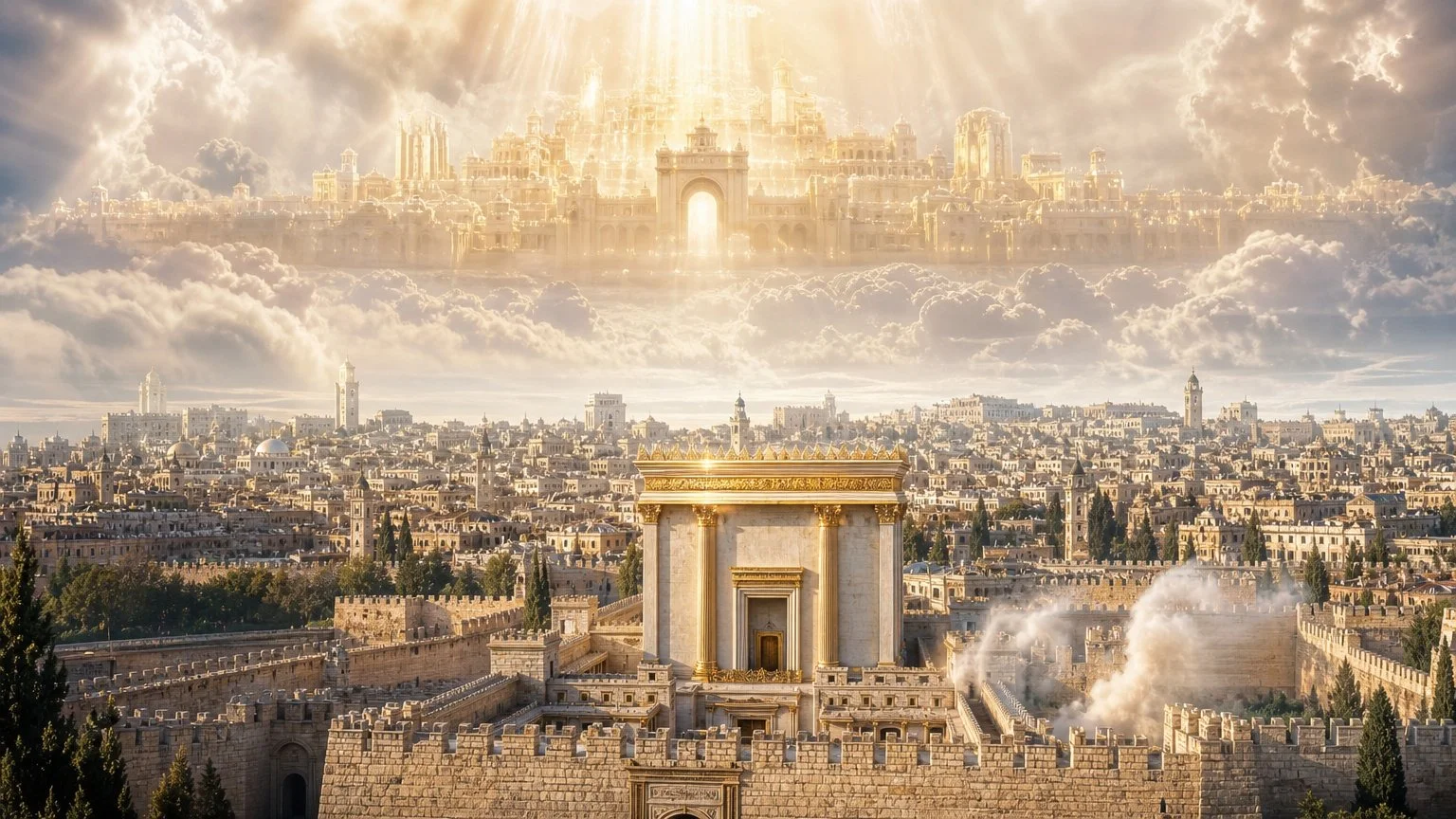
Jesus said that His Kingdom was not of this world, and in His transcendence, He rose into the heavens. God also said, “Heaven is my throne, and the earth is my footstool. Where is the house you will build for me? Where will my resting place be?” (Isaiah 66:1). And so it appears that God desires to build for Himself a house to be His permanent resting place. And yet, God occupies both realms, the heavenly and the earthly. And so will the resurrected church. Until there is a New Heaven and Earth, there will remain an earthly Jerusalem and a heavenly one. There will also be an earthly Mount Zion and a heavenly one. But in the Millennium, the heavenly realm will invade the whole earth. As it says, “For the earth shall be full of the knowledge of the LORD As the waters cover the sea” (Isaiah 11:9).
Concerning Zion, we read, “The Lord loves the gates of Zion more than all the other dwellings of Jacob” (Psalm 87:2). This verse in the Psalms might give the impression that God loves Zion more than Israel, but it is not an accurate translation. In the Masoretic text, the Hebrew word “mikol” is translated as “more than.” However, the more accurate translation is “from all.” In other words, God loves Zion from all of Israel. He has chosen Zion out of Israel to be His people and His resting place. Throughout Scripture, Jerusalem and Zion are often mentioned together.[xxxii] John saw a New Heaven and Earth, and he saw a holy city, the New Jerusalem, coming down out of heaven from God, prepared as a bride adorned for her husband.[xxxiii]
Therefore, we understand that God is calling His people to come out of the Old Covenant, represented by an earthly Israel and Jerusalem, to be transcended above the Law, into a spiritual realm, a heavenly Jerusalem that is free from the bondage of this fallen world. Hence, Paul said, “For this Hagar is Mount Sinai in Arabia, and corresponds to Jerusalem which now is, and is in bondage with her children—but the Jerusalem above is free, which is the mother of us all” (Galatians 4:25-26). When Jesus returns, the church will come with Him; heaven will invade earth. And at the end of the Millennium, when God’s final enemy is destroyed, which is death itself, He will make a New Heaven and a New Earth, and the heavenly Jerusalem will descend forever.
Concerning the people of Zion, we read, “Indeed, of Zion it will be said, This one and that one were born in her, and the Most High himself will establish her” (Psalm 87:5). God is not implying that people born in the physical land of Jerusalem are of Zion. He is speaking here of those born again of His Spirit, the church, and all who have received the Spirit of Adoption and have become the children of God. The church is awaiting its transcendence in the resurrection from corruptible, perishable bodies to incorruptible ones. From this perspective we can begin to see every covenant promise given to Israel as a temporal foreshadowing of an even greater fulfillment. It says, “His tent is in Salem [his temporary dwelling], his [permanent] dwelling place in Zion” (Psalm 76:2).
God said to Pharaoh, “Israel is My son, My firstborn” (Exodus 4:22). And yet Israel would wait another fifteen hundred years to receive the Spirit of Adoption, poured out on the Day of Pentecost, when those who received it would become the children of God. In speaking to His disciples, Jesus prayed, “The glory which You gave Me I have given them, that they may be one just as We are one” (John 17:22). In our resurrection, we also will be given glorified bodies. In the giving of the New Covenant, God says, “I will give them one heart, and I will put a new spirit within them, and take the stony heart out of their flesh, and give them a heart of flesh” (Ezekiel 11:19). Unlike Israel with its temporal Levitical priesthood and kingship that were purposefully separated, the church is called a Royal Priesthood per the order of Melchizedek.[xxxiv] The church is being transformed into the image of Christ, the King of Salem (Jerusalem) and Melchizedek, the priest of God Most High, whose name is translated as the “King of Righteousness.” We will rule and reign with Christ over His entire Kingdom in perfect justice and righteousness.
All of these examples demonstrate that the New Covenant not only fulfills the Old, but it transcends it. And in this sense, the church is not a “spiritual” replacement of Israel, as some proclaim. But rather, the church is entering into something mysteriously revealed as a “spiritual” Zion, as in the New Jerusalem. It is far greater than the temporary tent of God’s dwelling in Salem; it is His permanent dwelling in the heavenly Jerusalem. We read, “Beloved, now we are children of God; and it has not yet been revealed what we shall be, but we know that when He is revealed, we shall be like Him, for we shall see Him as He is” (1 John 3:2). Concerning the heavenly Jerusalem, it says, “You have come to Mount Zion and to the city of the living God, the heavenly Jerusalem, to an innumerable company of angels” (Hebrews 12:22).
In scripture, mountains symbolically represent kingdoms, and God’s Kingdom is called Mount Zion. We read, “Many people shall come and say, Come, and let us go up to the mountain of the Lord, To the house of the God of Jacob; He will teach us His ways, And we shall walk in His paths.” For out of Zion shall go forth the law, And the word of the Lord from Jerusalem” (Isaiah 2:3). Abraham also looked for something transcendent beyond this world. He was searching for a heavenly Jerusalem, as we read, “He waited for the city which has foundations, whose builder and maker is God” (Hebrews 11:10). Abraham was looking for a heavenly city; the heavenly Jerusalem built upon the heavenly Kingdom of Mount Zion.
Israel’s Restoration and the Millennial Kingdom
The understanding of the church’s transcendence above the Old Covenant might lead one to conclude that God is finished with natural Israel. Not so. There are innumerable prophecies concerning their future restoration and their coming to faith in the Messiah. There are also promises concerning the restoration of the Levitical priesthood, the sons of Zadok, and the Davidic dynasty, the sons of King David. However, the partial return of the Jewish people to the land of Israel, starting in the 19th century, does not mean they have necessarily transcended the Old Covenant, at least not yet. Israel is still largely rejecting their Messiah.
God made a conditional promise to Israel that He intends to fulfill, saying, “Today the Lord has proclaimed you to be His special people, just as He promised you, that you should keep all His commandments, and that He will set you high above all nations which He has made, in praise, in name, and in honor, and that you may be a holy people to the Lord your God, just as He has spoken” (Deuteronomy 26:18-19). As promised to Abraham, Israel was to become the church (a great nation and a company of nations), it presently sees the fulfillment of these and other promises given to Israel, including the promise of inheriting God’s Kingdom. However, because of Israel’s rejection, most of the Jewish people have forfeited these promises, and the Gentiles are freely receiving what was inherently for them.
Paul says this concerning Israel, “What then? Israel has not obtained what it seeks; but the elect have obtained it, and the rest were blinded” (Romans 11:7). The elect here is the church, and right now, it is primarily comprised of Gentile believers. Jesus affirmed this, saying: “The kingdom of God will be taken from you and given to a nation bearing the fruits of it” (Matthew 21:43). In this sense, the Gentile believers are one with believing Israel, spiritually, not losing their natural identity; they are the seed of Abraham and fellow heirs in Christ with Abraham’s natural seed.[xxxv]
Israel was and still is to rule the nations, as we read, “For the nation and kingdom which will not serve you shall perish, And those nations shall be utterly ruined” (Isaiah 60:12). But in their rejection, God has stripped away their Kingdom authority, and has given it away: “I say to you that many will come from east and west, and sit down with Abraham, Isaac, and Jacob in the kingdom of heaven. But the sons of the kingdom will be cast out into outer darkness” (Matthew 8:11-12). It is a sobering statement to hear that so many of the Jewish people, God’s covenant people, have rejected their calling and, thus, also their inheritance in Christ. But the elect, those who are in Christ, both Jew and Gentile, have obtained the transcendent promises that Israel longed for. And still, God is faithful to preserve a remnant of natural Israel for His glory and for His name’s sake. He will deliver them through the fire of tribulation, into their redemption and restoration in the land of Israel.
Israel’s complete physical restoration to the land promised to Abraham, Isaac and Jacob, and its spiritual rebirth into the New Covenant, are yet to be fulfilled in the future. Those who survive the tribulation, both of the Jews and the nations that are not part of the first resurrection, will join the ecclesia of God’s covenant people and enter the Kingdom to repopulate the earth. When the remnant of unbelieving Israel comes through the tribulation, all Israel shall be saved, as is written in Romans 11:26, and they will join the ecclesia of God’s people in His Kingdom.[xxxvi] Still, they are not resurrected, and, not being resurrected, they remain corruptible. Therefore, we find that in the Millennial Kingdom, there are two kinds of people: mortal men, as we currently are, and immortals, transcendent ones who are resurrected and have become like the angels (the first resurrection), perfected in the image of Christ to rule the nations in justice and righteousness.
We also find that in the Millennium there are many kingdoms across the earth; and at the center of Christ’s Kingdom is Israel, and its holy city, Jerusalem. The Jewish people will, at that time, inherit the land of Israel as an eternal possession. But there are also other nations, grafted into Israel, who have become one earthly people of God, and will likely inherit the other nations. As we read, “The Lord shall be King over all the earth. In that day it shall be—The Lord is one, And His name one” (Zechariah 14:9).
It is unclear what level of Kingdom authority those of Israel and the nations who come through the tribulation will have. There will be a restored Levitical priesthood and a restored Davidic dynasty; there will be a new Temple and daily sacrifices. Scripturally, it is clear that the church will govern all the nations with righteous authority. As it says, “He who overcomes, and keeps My works until the end, to him I will give power over the nations. He shall rule them with a rod of iron” (Revelation 2:26-27).
One New Humanity
There is a type or shadow in Scripture that shows how God set apart within Israel the tribe of Levi and the sons of Aaron as His possession. God took every firstborn (whom were redeemed back), and this one tribe of Levi, out of Israel, sanctifying and setting them apart for His service, saying, “You shall have no inheritance in their land, nor shall you have any portion among them; I am your portion and your inheritance among the children of Israel” (Numbers 18:20). The Levites were dispersed amongst the twelve tribes and were given lands and cities to inhabit, but not to possess. They were to be “one” with Israel and yet remain “sanctified” and set apart from them; an elect people within a kingdom.
The antitype, I believe, is the church. We are a chosen people of every tribe, tongue, and nation, redeemed by the blood of the Lamb, sanctified and set apart for Christ’s service. In this sense, we are “A chosen generation, a royal priesthood, a holy nation, His own special people” (1 Peter 2:9). We, like the Levites in Israel, are sanctified from the nations, but are also to be one with them, a holy nation within God’s Kingdom. The church will be resurrected incorruptible in the likeness of Christ, and therefore, it is we who are entrusted to steward God’s Kingdom. We will return with Christ to rule and reign with Him over the inheritance of His nations. Christ’s Kingdom is global, yet comprised of many kingdoms; it is a Kingdom of kingdoms. Jesus is the King of Israel, but He is also the King of kings and Lord of lords.
The New Jerusalem and the Eternal Kingdom
God does not have two covenant peoples. He has one, a remnant saved out of every nation, including the nation of Israel, as it says, “For You were slain, And have redeemed us to God by Your blood Out of every tribe and tongue and people and nation, And have made us kings and priests to our God; And we shall reign on the earth” (Revelation 5:9). The church is the redeemed of Israel plus the redeemed of the nations, Jew and Gentile together as “one new man” in Christ. We are the recipients of, and will see the fulfillment of, the covenant promises given to Israel. In this sense, we are a continuation of Israel, as Paul says, “The Israel of God.”[xxxvii] Still, God has a plan for the remnant of the unsaved Jewish people who endure the tribulation, and they will be united with the church in His Kingdom. As it says, “He shall give them up, Until the time that she who is in labor has given birth; Then the remnant of His brethren Shall return to the children of Israel” (Micah 5:3).
Reevaluating our table that distinguishes the covenant promises between Israel and the church, it becomes clear that the church is more than Israel. In this sense, the promises given to Israel are not solely fulfilled; they are expanded. The church is not one nation of Israelites, but a holy nation composed of every tongue and tribe. The church is not the recipient of conditional blessings but of unconditional, eternal ones. The church is not comprised of some priests and kings, but is a kingdom of priests and a royal priesthood. And in the resurrection, we will transcend this earthly realm and all its corruption, becoming like the angels. Thus, we are the heavenly Jerusalem that sits upon the heavenly Mount Zion.
Our Kingdom is not of this world, not yet. But we will return with Christ to the earthly Jerusalem and Mount Zion, to establish His heavenly Kingdom over every nation, including the nation of Israel. God’s Kingdom will be comprised of many unique and distinct kingdoms. At its center will be Israel and the Jewish people. The earth will become one people of God because they will all know Him, from the least to the greatest.[xxxviii] And the church will shepherd these nations, dwelling amongst the people as one family of God, yet also distinctly set apart to serve the Lord as a royal priesthood.
After the Millennium, the final transcendence of the creation will be in the New Heaven and Earth, and the New Jerusalem, which will descend from heaven; a transcendent physical and spiritual existence beyond anything our hearts and minds can conceive. Let us, therefore, seek to understand the great inheritance that we have in Christ, and let us participate in His Kingdom work amongst the nations, sharing the good news with all people, to the Jew first and then to the ends of the earth.
Scripture reveals that God has one redeemed people brought together through Christ—Jew and Gentile as “one new humanity.” The church does not replace Israel, nor does God abandon His covenant promises to the Jewish people. Rather, the New Covenant fulfills and transcends the Old, gathering all who believe into one flock under one Shepherd, while still preserving God’s faithfulness to Israel and His ultimate plan for their restoration in the fullness of His Kingdom. May we see the restoration of Israel and their salvation in Christ, even in our generation.
[i] All Scripture quotations are taken from the New King James Bible (NKJV) unless otherwise noted, Thomas Nelson Inc., 1982.
[ii] Jeremiah 31:31. Romans 9:1-5.
[iii] John 4:22.
[iv] Romans 11:5.
[v] Ephesians 2:15. Romans 11:27.
[vi] Romans 5:14. 1 Corinthians 15:45.
[vii] Genesis 17:20, 18:18.
[viii] Genesis 12:2, 17:4, 6, 35:11.
[ix] Ephesians 3:6.
[x] Ephesians 3:9, 5:32. Colossians 1:26-27.
[xi] 2 Chronicles 13:5.
[xii] 2 Corinthians 1:22. Ephesians 1:13, 4:30.
[xiii] Genesis 12:2. Joel 3:2.
[xiv] 1 Peter 2:9. Revelation 5:9.
[xv] Exodus 12:48.
[xvi] Isaiah 56:6. Zechariah 14:16.
[xvii] Numbers 25:13.
[xviii] Hebrews 5:6.
[xix] 2 Samuel 7:8-16.
[xx] Jeremiah 23:5, 33:15.
[xxi] Galatians 3:13.
[xxii] Jeremiah 31:31. Isaiah 55:3.
[xxiii] Ezekiel 16:8. Jeremiah 31:32. Isaiah 54:5.
[xxiv] Acts 15.
[xxv] 1 Corinthians 15:44, 46.
[xxvi] Deuteronomy 32:8. Isaiah 56:7. Zechariah 14:16.
[xxvii] Gateway Center for Israel. Replacement Theology—Perspective Paper; https://centerforisrael.com/papers/replacement-theology.
[xxviii] Psalm 8:2.
[xxix] Ephesians 1:11.
[xxx] Gafford, Joe Aaron II. Tenor of Our Times: The Life and Conversion of Augustine of Hippo. Harding University. 2015.
[xxxi] The Fathers of the Church, St. Cyril of Alexandria – Commentary on the Twelve Prophets, Vol. 2. Translated by Robert C. Hill. The Catholic University of America Press, Washington, D.C. 2008.
[xxxii] 1 Kings 8:1. 2 Kings 19:21, 31. 2 Chronicles 5:2. Psalm 51:18, 128:5, 135:21, 147:12.
[xxxiii] Revelation 21:2.
[xxxiv] 1 Peter 2:9.
[xxxv] Galatians 3:29.
[xxxvi] Romans 11:26. Psalm 14:7, 53:6.
[xxxvii] Galatians 6:16.
[xxxviii] Jeremiah 31:34. Hebrews 8:11.